
How to Train a Labrador Dog: Build Focus, Better Manners, and Reliable Recall

Training a Labrador dog starts the moment your new companion walks through the door-and getting it right early is the difference between a calm, responsive partner and a 70‑pound whirlwind that drags you down the sidewalk. If you’ve been wondering how to train a Labrador dog so that chaotic walks, counter‑surfing, and ignored recall become things of the past, this guide walks you through every step from first puppy sit to confident off‑leash obedience.
This article focuses on everyday obedience, behavior foundations, and off‑leash reliability for Labradors living in real‑world environments-your home, your neighborhood, and local parks-rather than competition obedience or field trial work. Whether you’re a new Labrador puppy owner, a family that adopted an adolescent or adult lab, or someone in Dayton, Ohio, searching for professional help, these strategies apply to you. Labradors are strong, energetic, mouthy dogs that can easily pull kids over, jump on guests, or ignore recall around distractions if not trained early and correctly.
Effective Labrador training combines short daily sessions of 5 to 10 minutes, consistent rules, high‑value rewards, and, when needed, balanced tools like an e‑collar introduced under professional guidance to achieve calm, off‑leash control.
By the end of this guide, you will:
- Understand what makes Labradors uniquely easy and challenging to train.
- Learn a step‑by‑step plan to teach core commands like sit, down, heel, and recall.
- See how to progress from on‑leash basics to distraction‑proof, off‑leash obedience.
- Discover how balanced methods (positive reinforcement plus tools) work in practice.
- Know when DIY training is enough and when to consider a board & train or private lessons.
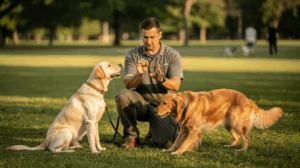
Understanding Your Labrador’s Training Needs
Training a Labrador really means channeling a high‑drive, people‑focused retriever into a calm, respectful companion at home and in public. Labradors are generally eager to learn and food-motivated, which gives owners a tremendous head start-but that same energy and intelligence can work against you if it isn’t directed properly.
Breed traits like boundless stamina, a powerful nose, and a mouth that wants to carry everything in sight directly affect how intense your training sessions need to be, which tools you pick, and how long the entire process takes. Understanding these dynamics before you start keeps expectations realistic and frustration low.
Labrador Temperament: Why They’re “Easy” and “Hard” to Train
Labradors are famously friendly, food‑motivated, and eager to please. Their working‑dog heritage means they were bred for generations to retrieve game, stay steady in water, and cooperate closely with a handler-traits that make teaching new commands relatively quick when owners are consistent. A Labrador puppy that knows a treat is coming will happily offer a sit, a down, or eye contact dozens of times in a row without losing enthusiasm.
The flip side is equally powerful. That retrieving instinct means your lab will happily carry and chew shoes, pillows, and TV remotes. A strong prey drive and scent obsession turn squirrels, puddles, and passing joggers into distractions that can overpower even a well‑practiced recall. Jumping on every person who walks through the door is simply your Labrador trying to get closer to the face it loves. Training a Labrador involves clear rules and rewards that appeal to their eager-to-please nature, but it also teaches patience-yours and the dog’s-because those competing drives don’t disappear overnight.
Recognizing both sides of the Labrador personality helps you set realistic training priorities: reward the behaviors you want, manage the environment so bad habits can’t rehearse, and build impulse control before expecting perfection in high‑distraction settings.
Stages of Labrador Development and What to Expect
Labrador development unfolds in distinct phases, and matching your training goals to each stage prevents wasted effort and unnecessary frustration.
8–16 weeks (Socialization and Imprinting). This is the most impressionable window. Start training as early as 8 weeks for best results. Exposures to people, surfaces, sounds, and gentle handling during this period have an outsized long‑term impact. Research confirms that puppies deprived of varied exposure between roughly 3 and 14 weeks show a higher risk of anxiety, fear, and aggression later in life. Early and varied socialization helps Labradors become well-adjusted adults.
4–8 months (Teenage Testing). Your once‑perfect puppy starts exploring independence. Recall deteriorates, pulling increases as strength grows, teething ramps up mouthing, and drives intensify. Owners often feel like obedience is regressing despite earlier progress. This is normal.
8–18 months (Adolescent Strength and Independence). Physical power peaks while emotional maturity still lags. Training must shift toward more complex obedience, proofing commands under distractions, and beginning off‑leash reliability in safe, controlled environments.
Adult Maturity (roughly 2–3 years). Labs often reach stable behavior around two years, though some don’t fully settle until three. Expectations for off‑leash obedience, impulse control, and manners should be high, but maintenance practice never truly ends.
Many owners in Dayton contact Off Leash K9 Training during the “teenager” phase when pulling, jumping, and ignoring recall become overwhelming. Understanding these stages prepares you to build the right foundation before asking for advanced off‑leash obedience.
Core Foundations for Training a Labrador Dog
Now that you understand your Labrador’s temperament and developmental stages, it’s time to build the foundation skills-structure, routine, and clear communication-that must come before fancy tricks or off‑leash work. Everything in this section is practical enough to start applying the same day you read it.
Creating Structure, Routine, and House Rules
A consistent daily schedule builds predictability and confidence in a Labrador, reducing anxiety and hyperactivity. Labradors thrive on structured training and clear boundaries, and when those boundaries are missing, destructive chewing, excessive barking, and over‑arousal at the front door are almost guaranteed.
Here’s a simple sample day for a 4–6‑month‑old Labrador in a busy family home:
- Morning: Wake up → potty break → brief leash walking (10–15 minutes) → breakfast → short training session (5 minutes of sit, down, eye contact).
- Mid‑morning: Rest in crate or contained area. (Crate training basics can help make this smooth.)
- Lunch: Recall or heel practice with a family member; structured chew time with an approved toy.
- Afternoon: Longer walk or play (fetch, swimming if safe), supervised exposure to neighborhood distractions.
- Evening: Dinner → place or down practice → calm family interaction → potty break before bed.
House rules should be clear and consistent across every family member: no jumping on people, no bolting through an open door before a “wait” cue, no counter‑surfing, and a set rest place (crate or bed) where the dog sleeps. Lack of structure is the single fastest route to a Labrador puppy that feels out of control.
Using Rewards, Corrections, and Balanced Training Ethically
Positive reinforcement means adding something desirable-a treat, a toy, enthusiastic praise-immediately after the dog performs a desired behavior, making that behavior more likely to happen again. Use high-value rewards to encourage desired behaviors; for most Labs, small bits of real chicken or cheese outperform dry kibble by a wide margin. Positive reinforcement builds trust and encourages engagement, and research shows it generally produces equal or better obedience results than aversive‑only methods, with faster response times and fewer repeated cues needed.
Balanced training pairs that reward foundation with fair, well‑timed corrections-such as leash pressure or a low‑level e‑collar prompt-once the dog clearly understands a command. An e‑collar is a low‑level communication tool, not a punishment device. When introduced correctly under professional guidance, it provides a consistent “tap on the shoulder” at a distance that a leash cannot reach. Labradors, with their resilient temperament and desire to please, often respond well when the e‑collar is layered over commands they already know. Use positive, pain-free techniques for lasting results, and avoid harsh physical punishments during training to maintain trust.
Timing matters enormously: a reward or correction delivered even two seconds late loses clarity. Every handler in the house must use the same cues and the same rules. If you’re unsure about introducing balanced tools, get professional guidance first-an improperly used e‑collar can create confusion or stress.
Socialization and Exposure for a Stable Labrador
Socialization is positive, controlled exposure to a wide variety of people, dogs, surfaces, sounds, vehicles, and public places-ideally between 8 and 16 weeks, though it should continue well beyond. The critical period from roughly 3 to 14 weeks is when absent or negative exposures can lead to lifelong fear or avoidance. Studies during COVID‑19 lockdowns showed that puppies with fewer socialization exposures during that window developed higher rates of fear, anxiety, and behavioral problems by six months.
For Labradors, poor socialization often doesn’t look like obvious aggression-it tends to show up as over‑excitement with strangers, leash reactivity, or anxiety in novel environments. Specific tasks include introducing your puppy to children, strollers, and bicycles; walking on grass, gravel, and pavement; hearing traffic noise at a comfortable distance; and meeting calm dogs in supervised settings.
For Labrador owners in Dayton, Ohio, early training can help establish good manners, basic obedience, and confidence in everyday situations. Off Leash K9 Training Dayton offers puppy training options to help owners build these foundational skills. Contact the team to discuss which program is appropriate for your puppy.
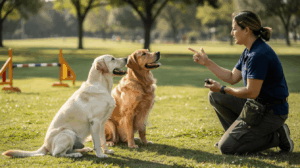
Teaching Essential Obedience Commands to Your Labrador
With structure and socialization under your belt, this is where training gets fun-and practical. Teaching basic commands such as Sit, Stay, and Come is vital for safety. Focus is essential for effective Labrador training, and regular eye contact improves a dog’s focus during training, so before each session, capture your dog’s attention with a “look” or name cue and reward that connection. Training sessions should last 5 to 10 minutes for puppies; short, positive sessions improve learning and retention.
Sit, Down, and Place: Everyday Calmness Commands
Sit and down are anchor behaviors that replace jumping, pacing, and begging. They’re the first step toward impulse control-the ability to choose calm behavior over chaos.
To teach sit, hold a treat at your dog’s nose, then slowly lift your hand upward and slightly back. As the puppy’s head follows, the rear drops into a sitting position. Mark with a “yes” and reward. For down, start from a sit, lure the treat straight down toward the floor, then slide it slightly forward. Once the behavior is consistent, add a clear verbal command and hand signal, then fade the lure so the dog responds without seeing food first.
“Place” means going to a designated bed, mat, or raised cot and staying there until released. This is a game‑changer for managing visitors, dinner time, and busy households. Shape the behavior by rewarding the dog for stepping onto the mat, then gradually increase duration. Recommend short sessions-3 to 5 minutes, several times per day-especially before meals and walks, to turn these into automatic habits.
Loose‑Leash Walking and Heel for Powerful Labradors
Labradors pull because excitement, scent, and forward drive make moving ahead self-rewarding- and this becomes genuinely dangerous once they reach 60–80 pounds. Teach loose lead walking through positioning and pace changes: when the leash tightens, stop all forward motion; when your dog turns back and the lead goes slack, mark and reward, then continue walking. Frequent changes of direction keep the dog guessing and engaged rather than locking onto a point ahead of you.
Start loose-leash training with a properly fitted collar or harness and reward your Labrador for walking beside you without pulling. Training tools should be selected based on your dog’s age, behavior, and individual needs. If you’re considering a slip lead or other specialized equipment, consult a qualified trainer to ensure it is used safely and appropriately.
Reliable Recall: Teaching Your Labrador to Come Every Time
Recall is the number one life‑saving command, especially for off‑leash hiking, parks, and open areas. Start recall training as early as 8 weeks old. Begin indoors where distractions are minimal: say your dog’s name, then “come,” and reward generously when the puppy arrives. Use high-value rewards to improve puppy recall effectively-whatever makes your dog’s eyes light up.
Practice recall in low-pressure environments before adding distractions. Move to a fenced garden or yard with a long line to transition to off-leash recall training, gradually increasing distance and difficulty. Building a recall that holds against real‑world distractions like deer trails or other dogs at the park requires hundreds of practice repetitions over months. Consistent practice builds reliable recall in Labradors-there are no shortcuts.
Later, an e‑collar can layer over the recall cue to achieve distraction‑proof reliability, but only after the dog already responds well on the long line. Never punish a dog when it finally comes back, even after a long delay-punishment poisons your recall and makes the dog less likely to return next time.
Impulse Control: Waiting, Door Manners, and Food Respect
Impulse control is your Labrador’s ability to resist an immediate urge in favor of a better outcome-waiting at a door instead of bolting, sitting for dinner instead of lunging at the bowl, staying in the car until released. Impulse control helps dogs choose calm behavior over chaos, and for a food‑driven, people‑loving Lab, it’s one of the most important skills you can build. Obedience training helps Labradors develop impulse control across every part of daily life.
To teach wait at doors: put your dog on a lead, ask for “wait,” and slowly open the door. If the dog moves, close it. Reward when they hold still, then release with a clear cue. For food respect: hold the bowl, ask for a wait, lower it, and only place it down when the dog remains calm. “Leave it” and “drop it” round out the toolkit-trade a stolen sock for a high‑value treat, and the dog learns that giving things up pays off.
Integrate these mini‑exercises into meals, trips out, and every time the dog approaches excitement rather than adding extra long sessions. Consistency in commands and cues is crucial for successful training-every family member must follow the same rules. Once these core commands are reliable on leash, you’re ready to move toward off‑leash control.
From Basics to Off‑Leash: Practical Training Plans for Labradors
Many owners stop after basic sit and down, but Labradors thrive with clear progression toward off‑leash freedom. That progression needs to be systematic-rushing it leads to a dog that ignores you at the worst possible moment. Training games can build focus and attention in Labradors throughout this process, keeping sessions feel rewarding rather than repetitive.
Step‑by‑Step Progression to Off‑Leash Obedience
This course of action is designed for Labradors older than 5–6 months who already understand basic commands on leash. Environmental distractions should be gradually increased during training sessions-never jump from a quiet living room to a busy dog park in one step.
- Solidify on‑leash obedience for sit, down, heel, and recall in low‑distraction areas like your home or quiet garden.
- Add a 20–30‑foot long line in a fenced yard or quiet field to practice recall and heel with more distance while maintaining a safety net.
- Introduce the e‑collar at low levels under professional guidance, pairing it with commands the dog already knows well. (Learn more about e‑collar methods.)
- Gradually reduce reliance on the physical leash as the dog responds consistently to verbal cues and e‑collar prompts.
- Add controlled distractions-other dogs at a distance, kids playing, wildlife-while maintaining responsiveness at each step.
- Transition to fully off‑leash sessions only once the dog responds reliably under real‑world distractions in safe, legal, enclosed environments.
This process may take weeks to months per phase depending on your dog’s age, temperament, and prior exposure. Labradors require structured recall training for off-leash safety; skipping steps almost always means going backward later.
Comparing DIY Training, Group Classes, and Board & Train Programs
Many Labrador owners are unsure whether to keep training at home, join a group class, or invest in a board & train. Each path has clear trade‑offs, and the right choice depends on your dog’s behavior, your schedule, and your goals for off‑leash reliability.
| Criterion | DIY Home Training | Group Obedience Classes | Board & Train with Off Leash K9 Training Dayton |
| Owner time needed | High (daily practice, self‑study) | Moderate (weekly class + homework) | Lower during program; high for maintenance after |
| Speed of results | Slower; depends on consistency | Moderate; structured progression | Fastest; immersive professional environment |
| Cost | Lowest (treats, leash, long line) | Mid‑range (per‑class or package fee) | Highest (see plans & pricing) |
| Professional guidance | Minimal unless supplemented | Present but shared among class | Dedicated, one‑on‑one or small group |
| Ideal for | Motivated owners with young puppies | Socialization + early obedience | Serious behavior issues, adolescent regression, off‑leash goals |
| Off‑leash readiness | Possible but long timeline | Unlikely without additional private work | Primary goal of the program |
If you have a young Labrador puppy, strong motivation, and time each day, DIY training can produce excellent success. Group classes add valuable socialization and structured distraction. A board & train program delivers the fastest behavior changes-especially for adolescent Labs that are already pulling, jumping, and ignoring recall-but the owner must maintain follow‑through after the dog comes home, or progress fades.
No matter which path you choose, you’ll face common Labrador‑specific challenges that can be solved with the right strategy.

Common Labrador Training Challenges and How to Fix Them
Even with a solid plan, Labradors present recurring behavior issues fueled by their enthusiasm, energy, and retrieving instincts. The good news: every one of these problems has a clear, actionable fix. Short training sessions of 5-10 minutes enhance focus and are usually enough to work on any single challenge.
Excessive Jumping on People
Your lab throws itself at guests the moment the door swings open, launches at kids when they run through the house, and body‑slams strangers at the park. The dog isn’t being bad-it’s trying to get closer to the faces it loves.
The fix: teach an alternative behavior that’s incompatible with jumping. A dog in a solid sit or on its place mat physically cannot jump. Control the environment with a leash or tether when expecting guests, and consistently remove all attention-turn away, fold arms, no eye contact-when the dog jumps. Structured greeting routines combined with place training can nearly eliminate jumping within a few weeks. Everyone in the house must agree on the same response, or the dog learns that jumping works on some people.
Pulling on the Leash and Dragging Owners
Labs quickly learn that pulling gets them where they want to go faster-and once they reach full size, a walk turns into a tug‑of‑war you cannot win with strength alone.
The clear correction strategy: the instant the leash tightens, stop all forward motion and wait. When the lead goes slack, mark and reward, then continue. Throw in frequent direction changes to keep your dog paying attention to you instead of locking onto distractions ahead. For strong adolescents where the problem is already severe, professional help and balanced tools-like e‑collar conditioning introduced by an experienced trainer-make the process faster and safer.
Mouthing, Chewing, and Stealing Objects
Labradors are bred to carry things in their mouth. That instinct doesn’t disappear because you’d prefer your shoes stayed intact. Chewing is also part of developmental teething, and boredom or overstimulation makes it worse.
The strategy: manage the environment with a crate and baby gates so your lab can’t practice bad habits unsupervised. Provide plenty of legal chew items-rubber Kongs, bully sticks, frozen stuffed toys. Teach “leave it” and “drop it” using a trade: the dog gives up the stolen sock and receives a high‑value treat. Structure retrieve games so the dog’s need to carry and pick up objects is met in a controlled, fun way. Meeting the mouth drive reduces destructive habits far more effectively than scolding after the fact.
Ignoring Recall Around Distractions
Squirrels, other dogs, ponds, and happy strangers calling your lab’s name-all of these are naturally more rewarding than returning to you, at least until you make coming back the best option available.
The solution: go back to long‑line practice in a fenced area. Increase the value of your rewards-use whatever makes your dog sprint toward you. Once the dog reliably responds on the long line across varied distractions, a balanced trainer can layer e‑collar reinforcement to extend reliability at greater distance. Research indicates reward‑based recall tends to produce equal or better response times with less welfare risk, so keep rewards at the center of your approach. Do not practice off‑leash freedom in open areas until recall is rock‑solid with a safety line attached. Overcoming this hurdle turns a wild Labrador into a confident, happy, enjoyable partner.
Frequently Asked Questions
1. At What Age Should You Start Training a Labrador?
You can start training your Labrador puppy as early as 8 weeks old. Begin with simple commands like sit, come, and stay, along with potty training and socialization. Keep sessions short, around 5–10 minutes, and use positive reinforcement to encourage good behavior.
2. Are Labrador Retrievers Easy to Train?
Yes, Labrador Retrievers are generally easy to train because they are intelligent, food-motivated, and eager to learn. However, their high energy and excitement can make training challenging. Consistent routines, clear commands, and rewards help Labradors develop good manners and obedience.
3. How Long Does It Take to Train a Labrador Dog?
Basic obedience training can take several weeks to a few months, depending on your Labrador’s age, temperament, and consistency. More advanced skills, such as reliable recall and off-leash obedience, may require several additional months of regular practice.
4. How Do I Stop My Labrador From Pulling on the Leash?
Start by rewarding your Labrador for walking beside you with a loose leash. When your dog pulls, stop walking and wait until the leash relaxes before continuing. Practice in quiet areas before introducing distractions. Consistent training helps your Labrador develop better leash manners.
5. Can You Train an Adult Labrador Retriever?
Yes, adult Labradors can learn new commands and improve unwanted behaviors at any age. Start with basic obedience, establish consistent routines, and reward desired behaviors. Older Labradors may need additional practice to change established habits, but patience and consistent training can produce lasting improvements.
Conclusion and Next Steps
Training a Labrador dog is about channeling relentless energy through structure, clear obedience commands, and consistent daily practice until off‑leash reliability becomes routine. There is no magic shortcut-just steady work that builds trust, impulse control, and real‑world manners one session at a time. The same traits that make Labs challenging-drive, intelligence, enthusiasm-are exactly what make them extraordinary companions once that energy has a productive outlet.
Your immediate next steps:
- Pick 2–3 foundation commands (sit, place, recall) and practice daily this week in short 5‑to‑10‑minute sessions.
- Set a simple routine for walks, training, meals, and rest that your lab can rely on every day.
- Decide your training path: continue DIY, join a group class, or schedule a consultation with a professional.
Owners in the Dayton, Ohio area can schedule a free phone consultation with Off Leash K9 Training Dayton, Ohio to discuss board & train, private lessons, or in‑home sessions tailored to their Labrador’s age and behavior. You might also explore related topics next, such as advanced off‑leash hiking etiquette, e‑collar maintenance and safety, or preparing a Labrador for therapy or service roles.
Additional Resources
These resources are optional deep dives for owners who want more support or technical detail beyond what this guide covers.
- Blog & videos: Browse the Off Leash K9 of Dayton blog for posts on recall, heel, and e‑collar introductions specific to balanced training.
- Training milestones by age:
- By 6 months: reliable sit, down, place indoors; beginning loose‑leash walking; socialization well underway; recall solid in low distraction.
- By 12 months: heel on leash in moderate distraction; recall on long line in open environments; impulse control at doors and mealtimes.
- By 18 months: off‑leash obedience in controlled real‑world settings; reliable recall under high distraction; calm greetings with guests.
- Essential gear for Labradors: 6‑foot leather or biothane leash, 20–30‑foot long line for recall work, raised cot or durable mat for place training, properly fitted e‑collar when introduced under professional guidance.
- Professional help for serious issues: If your Labrador shows aggression, severe anxiety, or resource guarding, schedule a professional behavior consultation rather than attempting DIY correction. These issues require expert assessment and a tailored plan.
Would you like a certified trainer to contact you?
PPC Contact Form
"*" indicates required fields
